Saturday, June 19, 2010

The Shackled Continent (Part VI)...My Take and Charter Cities

My Take


The Shackled Continent did exactly what it promised; it unraveled Africa’s web of complicated problems.  This book was readable, descriptive, pragmatic, and genuinely sympathetic.  


What I liked.  Guest is a passionate hard-nosed capitalist; so many of his ideas resonated with my understanding of Africa.   He believes that “thugocracies” of many African countries have restrained the entrepreneurial talents of Africans.  And that Africans have largely been impoverished by their own leaders.  Guest goes on to say in regards to colonialism, 


Foreigners sometimes really are to blame. Africans have suffered, and its only natural that many should bear grudges for the wrongs of the colonial period....but railing against outsiders may be cathartic, but it dose not achieve much.  Wiser Africans do not wish to be seen as victims.  


Guest squarely puts the responsibility for Africa to succeed upon its leaders.      


What I didn’t like.  Guest doesn’t give much advice in regards to solutions for African leaders to adopt.  After reading the conclusion “One Step At A TIme,” I was left wanting more than Africa should look to the country of South Africa as a model of success and follow its lead little by little.  Why should we believe anything will change when it has always been this way.   


I also disagreed with Guest’s negative opinion of foreign aid to Africa. I think he fails to make a differentiation between government aid (which is largely inefficient...The value of “dead capital” in poor countries--that is, property which cannot be capitalized because of the lack of a title deed - is roughly forty times the foreign aid received by the world since 1945) and aid privately directed to NGO’s or mission agencies.  I’m biased and of course believe in what we are doing here at Kijabe.  And I see how the lives of people and communities are changed not just by the physical care they are given, but also by the transforming power of the Gospel.  Guest is wrong to denounce all aid as counterproductive.


What are the best minds saying?  Are there any other solutions?


Charter Cities; A Creative Solution


Paul Romer an economist from Stanford is trying to help the poorest countries become rich.  His ideas (written by Sebastian Mallaby) whether you agree or disagree are worth reading.  


Romer is peddling a radical vision: that dysfunctional nations can kick-start their own development by creating new cities with new rules...centers of progress that Romer calls “charter cities.” By building urban oases of technocratic sanity, struggling nations could attract investment and jobs; private capital would flood in and foreign aid would not be needed. And since Henry the Lion is not on hand to establish these new cities, Romer looks to the chief source of legitimate coercion that exists today—the governments that preside over the world’s more successful countries. To launch new charter cities, he says, poor countries should lease chunks of territory to enlightened foreign powers, which would take charge as though presiding over some imperial protectorate.


To drive home the importance of good rules to economic growth, Romer sometimes shows a photograph of Guinean teenagers doing their homework under streetlights. The line of hunched, concentrating figures presents a mystery, Romer says; from the photo it is clear that the teens are not dirt poor, and youths like these generally own cell phones. Yet they evidently have no electric light at home, or they would not be studying by the curbside. “So here is the puzzle,” Romer declares: Why do these kids have access to a cutting-edge technology like the cell phone, but not to a 100-year-old technology for generating electric light in the home? The answer, in a word, is rules. Because of misguided price controls in the teenagers’ country, the local electricity utility has no incentive to connect their houses to the power grid. Their society lacks the rules that make technological advance meaningful.

The standard response to this obstacle is to advocate democracy and hope that voters will force change: the minority that has electric light will be outvoted by the much larger number of people who have been denied it. But Romer argues that this way forward is too slow. People don’t always vote their economic interests, and elites with tentacles all over the ministry of energy may keep price controls in place for decades. So rather than wait in vain for electricity rules to change, we are better off starting a new experiment with brand-new rules—a charter city that stands outside the ministry’s authority.

Reviewing this book on one hand was discouraging and overwhelming, but also kept me mindful of  the world's utter dependence upon God in the face of Africa's mighty obstacles.  


Friday, June 18, 2010

The Shackled Continent (Part V)

The Conclusion


Robert Guest believes the bottom line is that “if Africa were better governed, it would be richer.” He makes the comparison of a good government (South Korea), and a bad government (North Korea).  One lives with scarcity the other with plenty.   One with dark homes the other with electricity.  One with fear of government and threats of being thrown in a labor camp, and the other with freedom of the press and capitalism.  


He goes on to compare Zambia with North Korea.  Zambia in the 1960’s had rich copper mines, that a well intentioned president with plenty of foreign aid quickly nationalized.  The mining industry became bloated and corrupt.  When the price of copper fell the industry could no longer be profitable. The copper mines were shut and now Zambia is poorer than it was 50 years ago.


Contrast Zambia with Botswana, which he compares with South Korea.  Botswana has one of the deepest supply of diamonds. Botswana used this resource wisely and plunged money into infrastructure, health care, and education.  Private business was encouraged.  Government was one of integrity.  The budget was in surplus.  Income grew from subsistence to well over $3000 per person in 35 years.  


But Botswana is a small country of million people.  The size of perhaps one of the larger slums (Kibera) in Nairobi.  Africa needs more Botswana’s, and saner politics could make that happen.

Thursday, June 17, 2010

The Shackled Continent (Part IV)

 If you made it though the litany of thorny problems Africa faces, surprisingly we are only to page 28 in Guest’s "The Shackled Continent".  We have finished the Introduction: Why is Africa so Poor? The next 9 chapters include titles like, “No Title”,  “Sex And Death”, “The Vampire State,” and “Wiring the Wilderness.”  They are equally discouraging including explanations of Trucker Prostitution in South Africa, the demoralizing fall of a once great nation of Zaire into the  Democratic Republic of Congo, & the horrors of the genocide in Rwanda.  You can read the book to see what Guest has experienced.  


Let me share two experiences here in Kenya (not nearly as dramatic), but similarly revealing. I don’t share this to be mean-spirited, but rather to show that Kenya is still developing and I often don’t understand why it functions as it does.


A dental NGO (with Christian roots) contacted me about coming to Kenya last year.  Their NGO had success working with Rotary to set up portable dental clinics in Latin American schools.  Their clinics are staffed by national dental graduates who are required to give one year of service.  They have over 8 clinics and treat hundreds of kids each year. Two members of this NGO flew out to Kenya to see if this idea would fly here in Africa.  I was able to arrange a meaning with the Ministry of Health.  The NGO (myself in attendance) graciously presented their idea to the Minister and offered to donate the first two portable dental chairs.  What seems like a no-brainer in a country with big need (ratio of dentists to people is 1/378,000 in the public sector).  Why decline donations at the cost of your nation’s own children? It was met with silence.  And as far as I know despite several more requests to help in Kenya, the NGO never head back from the health minister. 


Between our short drive from Kijabe to Nairobi there are at least three police roadblocks in our way.  Spikes on the left and right, a few policeman with batons, and traffic funneled to one lane signify an upcoming roadblock.  If you are fortunate (which we have been so far) you are waved on through to Nairobi.  If the policeman feels so inclined he can direct you to the side of the road.  Apparently the police force is underpaid and it is understood that they supplement their salaries in “creative ways.”  Our good friend was riding as a passenger when stopped at a roadblock.  She was threatened to be thrown in jail for not wearing her seatbelt if she did not pay the officer a fine.  I know of another large  missionary family who was stopped at a roadblock for no apparent reason.  They were given a citation for having a tire that was partially deflated.  The driver (Dad) refused to pay.  The officer began to to arrest and detain the father. “OK, but you will have to take our whole family to jail.” Mom, Dad, and four children embarrassed the officer by spreading their legs, placing their faces against the windows, and raising their hands behind the head (even the four year old).    The humiliated police officer pleaded them to stop and quickly reneged his bribe attempt.


I could go on but with more examples but I don’t wish to tread on Kenya: a good country with great people.  Let's move on to possible solutions?  Next posts will look at what Robert Guest believes Africa needs to progress, a creative solution by Romer called “Charter Cities”, and my final take on this book.

Wednesday, June 16, 2010

The Shackled Continent (Part III)


5)Africa can hardly be prosperous because of the advance of AIDS.  Thirty million Africans are infected with AIDS.  Three quarters of the world’s AIDS deaths occur in Africa. Life expectancy while rising in the West has fallen in Africa due to HIV. Poverty accelerates the spread of HIV.  Without antibiotics open sores are not treated, and the virus is transmitted more readily.   Poverty of education has also speeded the spread of AIDS.  Some African women believe that without regular infusions of sperm, they will not grow up to be beautiful.  Some African men believe that by having sex with a virgin  they can cleanse themselves of the virus.  The disease strikes people in their prime years (not a disease of the elderly like alzheimers).  Fathers lose jobs, families lose homes, and children are orphaned.  


6) African countries are chronically unstable.  Most  Africans feel more loyalty to their tribe than their nation.   Nepotism is rampant among “elected officials.”   Corrupt politicians use tribal-alliances  to their advantage.  The genocide in in Rwanda of the Tutsis was carefully planned by the Hutu politicians.  Hutu politicians to keep themselves in power coordinated a mindset to hate and kill Tutsis.  Using tribal alliances approximately 800,000 Tutsis were murdered in six weeks; the swiftest genocide in history. 


7) Wealthy countries have too many trade barriers that prevent African countries from selling their exports at reasonable prices.  Africa has fertile land, plenty of sun, and cheap labor. But wealthy countries through quotas, tariffs, and national farm subsidies create an environment where African producers cannot compete.   


8) Civil wars set back countries in Africa and prevent success.  In 1999 1/5 Africans lived in a country currently in civil war.  90% of casualties in civil wars in Africa are civilians.  19 million Africans have been force to flee their homes.   The poorest 1/6th of humanity endures four fifths of the civil wars. What are the risk factors for a civil war: poverty and stagnation.  As the saying goes, “it is easy to give a poor man a cause.” In a vicious cycle of poverty-war-more poverty, it has been shown that a civil war reduces average income by 2.2 percent each year. 


9) Africa needs more successful business but doing business in Africa is risky.  Bad roads and “hungry policeman” at roadblocks makes it costly to move goods even a short distance.  Imported business to Africa say BYOI (Bring your own infrastructure). 


10)Term limits for presidents before the 1980’s in Africa were almost non-existent.  Without term limits bad presidents are never voted out of office.  And without constitutions rogue governments cannot be kept in check.   


11) Most countries in Africa have underdeveloped property rights.  For example in Malawi a person cannot buy or sell land without agreement from the village chief.  If he is able to buy the land but leaves it unattended for a short time the land can be taken .  We take property rights for granted.  In a country with strong property rights you have incentive to improve your land, you can use your land as collateral for a loan, you can divide your land and share assets.  Furthermore, owning land gives you an address. This allows you the ability to develop a credit record, identifiable assets, an incentive to pay off your loans, ability to get electricity, a phone line, the ability to business with strangers.

Tuesday, June 15, 2010

The Shackled Continent (Part II)


Continuing the review of “The Shackled Continent” by Robert Guest, we look at what prevents Africa from finding prosperity.  As you can imagine the problems are complex, multifactorial, and inter-related.  Guest does a superb job laying out the difficulties Africa faces; one problem after another, after another, after another.  


1) Because Africa has the worst diseases, it prevents the population from working at full capacity consistently.  Malaria, yellow fever, Ebola, meter-long tape worms are just a few of the ailments that plaque Africa’s work force.  Any of these sickness if not causing death can make the patient too sick to work for months.  It’s hard to be prosperous and efficient when you can’t get out of bed due to illness.


2) Centuries ago millions of Africans were kidnapped, chained to boats, and forced into slavery.  Those who were not captured lived in fear and hiding.  While the rest of the world was advancing into the industrial age, Africa remained unchanged or perhaps digressed.  How can a continent succeed when its workforce has been shackled?  Of course slavery is the worst kind of evil possible, but it can’t be blamed for all of Africa’s problems.  And one can be angry, and place blame...but ultimately it hampers not helps with looking forward to possible solutions. If todays problems are that of the West; then all you can do is demand the West solve them.  The West is mostly not feeling guilty anymore from what great-great-great grandfathers did and also has not been at times incredibly unsuccessful with solutions.


3)Colonialism remained into the 1960’s and 1970’s.  Colonialism demoralized countries by conquering with ease, drawing arbitrary borders, and crippling African minds with a belief that Africans could not rule themselves.   Colonialism left deep scars and it is a good thing African countries gained their independence.   But it also left a lot of good things like roads, hospitals, and education systems.  70 percent of Africans today were born after independence.  Other countries have experienced colonialism and recovered.  Korea was annexed by Japan in 1910 and today is a modern, productive economy and incidently sending more missionaries to Africa than any other nation expect the United States.


4) Africa has suffered from a failure of leadership. The character of the people is hard-working, the climate is right for agriculture, the land is ripe for growth, and the diverse geography is prime for tourism.  But African leaders have failed to rise to the challenge of personal responsibility. Governments have failed the African people.  Property rights are not upheld, freedoms are not insured, and created private wealth is preyed upon.  Look at Mugabe’s Zimbabwe, where a portrait of their president hangs in every shop and everyone fears to take it down.  He seizes private property.  He sets fix prices for gas and corn causing artificial price spikes or national shortages. His wife goes on expensive shopping weekends in London until she is kicked out of the country, while Zimbabwe residents live on less than $400 per year.   And he prints money at will, causing hyperinflation (a wheelbarrow full of cash is required to pay for a sandwich).  


  (To be continued)


Monday, June 14, 2010

Coppelia - A Ballet in three Acts (by Meredith)

After reading and writing about the problems Africa is shackled with, I honestly got a little depressed and decided I needed a brief interlude (I'll be back with the second and third parts later this week).  

So with no further ado I present something that is gratuitous, has nothing to do with Africa or missions, yet is completely enjoyable; Meredith (on the right) in Coppelia.  (Just click on the play button in the bottom left hand corner of the screen.)

A Shackled Continent (Part 1)

If you were to take the 50 km drive from Kenya’s capital city of Nairobi up to the West Highlands and then down the s-curved, washed-out entrance leading to Kijabe Mission Hospital you would find a peculiar sight.  Groups of boys ranging from 6 years old up to 15 with dirt in their palms and a facial expression of surprise, as if to say,  “look what I have done” approaching and tapping on your window.   It doesn’t seem like they are doing anything, until you look at the road (if you can call it that) a little closer.   And you will begin to see that what the boys are doing.   They are scooping dirt from hills and plugging the pot-holes on the road one-by-one.  By doing such they give the driver a softer ride, and hopefully elicit a donation of few Kenyan Schillings.  Of course, this road repair-job is a hopeless act, and only lasts until the next rainfall splashes the soil out of the pothole and back into the ditch; causing the potholes to widen and deepen. 


After living in Africa through seven seasons the big problems Africa faces can become a little discouraging.   And it can seem that youth filling potholes with dirt can epitomize the plight of Sub-Sahara Africa; plugging problems  (joblessness, AIDS, woeful infrastructure, war, lack of healthcare, and government corruption) not with lasting solutions, but quick fixes that simply insure further deterioration.


    Over the next few posts I want to take a look at the book “The Shackled Continent; Power, Corruption, and African Lives” by Robert Guest.  Not an encouraging read at all, but necessary; as sometimes you can’t but help but ask, “Why Africa, do you have so many seemingly intractable problems?”

Saturday, June 12, 2010

More Missionaries or More Millionaires?

Arthur S. DeMoss began his life working as a bookie. He owned three Cadillacs by age 24. A year later, DeMoss turned his life over to God and said, "'I'm gonna give my life to full-time Christian service." 

It was asked of De Moss if he was going to be a missionary and leave the life of business. He said, "Oh, no. We have enough missionaries. We need people who will make a huge amount of money to support missionaries.'" DeMoss then proceeded to turn a home based company into one of the largest health insurance companies in the country.  At the time of his death at age 53, his estate was estimated at 350 million dollars.  DeMoss stayed true to his word to support missionaries (His politics aside). Over half of his estate was used to support ministries like Prison Fellowship, Samaritan's Purse, Bibles for Little Ones, and Africa Ministries.   I guess he became what he wanted to be; a Christian Millionaire.  

      It's common in developing world missions for presenters to use pictures like the one below in blogs (I've done it), newsletters, powerpoint presentations, etc to make a point.   

But I wonder what is that point?  Is it that we live in a sinful and often corrupt world where too many people are stricken by poverty, sickness, despair, and hunger?  Or is the point that poverty, sickness, despair, and hunger exist because there is an income discrepancy between you (the reader) and those you are gazing upon? 

I think guilt as a motivation to giving for missions is probably highly effective in the short term.  We are all swayed by our emotions after seeing breathtaking photos of little ones in dirty clothes, no shoes, and sad faces.  And it produces tremendous responses to disasters the likes of Hurricane Katrina, and the earthquake in Haiti.  And there is probably something to righteous guilt...something inside you (Holy Spirit) pressing you that there are wrongs that need to change and you have the financial wherewithal to do something.  
 
But in the long term using guilt and emotive pictures is a questionable tactic for many reasons.  First, God desires of us a generous, happy, and content giver; not a grumpy, reluctant, skeptical giver.  Second, we can never give away enough to make the poor rich (we can't and shouldn't try to make African groups in to middle class Americans).  Third, earning legitimate money should not bring about guilt.      

So, while I would disagree with De Moss that we have enough missionaries (there are still far too many sick, unreached, and poor). I wholeheartedly agree that we need more people "who make a huge amount of money to support missionaries."  And people who are talented, content, driven, and lead to do as such.  

Thursday, June 10, 2010

Goodnight

      As Amelia (almost 7) and Meredith (getting closer to 4 than 3) grow up, I wonder if these moments will become even more rare?

Tuesday, June 8, 2010

Kicked By A Goat


        Most of my patients are fairly Westernized as far as language (English or Swahilli), dress (blue jeans, and collar shirts), food (white bread and coca-cola), and culture (mobile phones).  But we do have some Masaai patients.  They have held true to their language (Masaai), dress (colorful beads, red blankets draped over their shoulder toga style, heavy earrings that distort their earlobes, and often carrying a staff), food (all meat and milk diet....the original Atkins), and culture (mostly nomadic cattle herders).  


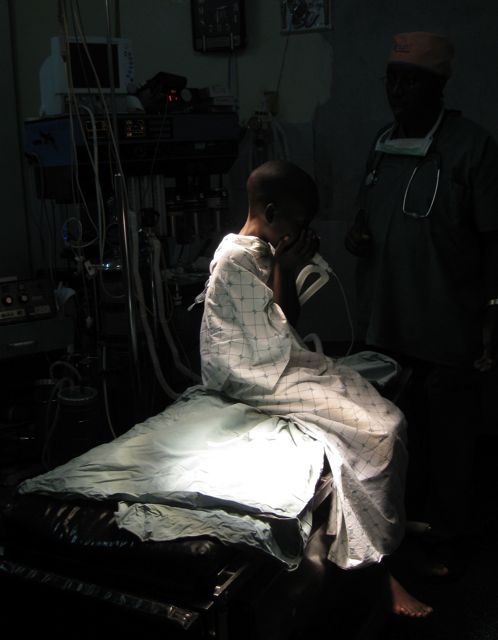
     This boy was kicked by a goat.  Three of his teeth were intruded and are no longer visible.  They are hidden up under the nose into the soft tissue wound.  


    Practicing "deep breaths" as the sedative gasses are coming soon to go off to sleep.  

  Family together (Dad must be about 6 and 1/2 feet tall and weigh about 150 lbs).  I imagine he could walk in the Bush for days with little to drink or eat and be just fine.  Their son is a little less swollen and the teeth repositioned and splinted.  
 

Saturday, June 5, 2010

More Than Crumbs

      In an old missionary autobiography, the author describes how the only support his family received was the left over crumbs.  When back visiting their home church on furlough, first the regular offering plate would go around.  Then the second plate would go around and his family would watch, just hoping their was enough for his family to survive.  All the time seeing the offering plate not as an act of generosity, but more akin to panhandling.  He claimed that while in Africa they received such donations as used tea bags (Does a teabag still have flavor after 6 months?).  Living off a crumbs reminded me of these 3 warthogs balanced on their knees scrambling to snort up the left-overs.  Fighting over crumbs.  

Our experience has been just the opposite.   Rather than scrambling for crumbs, your support for our family and the medical/dental ministry in Kenya has been abundant, thoughtful, and creative.  

A class of Sunday school students sending cards and pictures to Amelia and Meredith and adopting them into their class.  The girls read and reread every card.   

A seller on Amazon refunding my purchase fee on a used Christian book after accidentally finding out we were missionaries with Samaritan's Purse.  He insisted he send the book at no cost.  Thanks, I will probably never know who you are.

Faithful family, friends, and churches who month after month give generously to our project account.  Seeing your name every month provides encouragement and accountability.

A women's group who knits warm hats for premature babies in the NICU.  Little heads are warm.

The care packages of things we can't get in Kenya (chocolate chips, stickers, home-made t-shirts for the girls, Starbucks coffee, Poptarts, Crystal Light).  A taste of home is appreciated.  

The one time donations at times from strangers that comes just at the right time to support a project in need.  We are often surprised.

A waitress nearly 2 years ago who was at church the same day of our missions conference and paid our dinner tab. I'm sure out of her own salary, not the restaurant.  Thank-you.  

And all the other unspoken prayers and encouragement we may never know about.  I assure you it has all been exceedingly More Than Crumbs.


Friday, June 4, 2010

Your Generosity Has Done This...Part V


This Chappell grand piano was donated to AIC church in Kijabe in 1963.   When we arrived this grand piano had missing strings, was sitting cattywampus because of a broken front leg, and was sorely out of tune.  Apparently, some children forced their way into the church and started  jumping on the piano for several days until someone realized what had happened.  Consequently the lid has been shut on this fine grand piano for the past year; silenced and dysfunctional.  

 Well, that didn't sit right.  It says in Psalm 33, 

Sing to him a new song, 
Play skillfully and shout for Joy.   


Thanks to many of your generous donations the piano is making music once again.   Because of your donations, funds were available to repair the broken leg, replace the missing strings and tune the piano (not an easy thing in Kenya to find a piano tuner) to pitch.   God is glorified through music.  And God is also glorified in your giving.  Thank-you!   

Wednesday, June 2, 2010

Something beautiful

It started as a way to memorialize what I've lost. A way to help me grieve and exteriorize some of the pain I've carried. Pain and grief from the frequent, recurrent pregnancy losses as well as from being with those dying, who have lost babies, who were entrusted into my care and things didn't go as expected and from seeing some things hard to even describe. 

Having never quilted before a simple log cabin pattern was recommended to me. This pattern also contains a central hearth or heart to it and I liked the idea that what came out from the center arose and centered around the heart. 
I did find comfort in the hours of stitching and hours of removing stitches. It metaphorical spoke for the ways God acts in our lives putting things in and pulling other things out. Trying to piece my imperfectly square pieces reminded me that flaws can be overcome as in life by God's grace. Someone offered to quilt the top and took away something I was incapable of doing. Just as Christ made us right with God something we are completely incapable of.  So that somehow when all is said and done it comes together. 


Beauty is found. Life is restored. Hope is renewed. 

Snowsuits and Sundresses


        Amelia and Meredith's friend Jane came over last night wearing the following neck to ankle zip-up/button-up snowsuit and baclava hat.  It was dark and slightly windy , yet the temperature at Kijabe was probably a mild 55 degrees F.   I think the last time I wore a Snow Jumpsuit I was snowmobiling in Yellowstone Park in -23 F conditions.  

Jane's Mom came over to borrow our bunny rabbit for a week.  I asked why, and she said they needed it to breed (their four bunnies are female and our Flower is male).   What is the breeding for?  The meat.   We will see what Flower can do in a week.   

        Meredith dresses herself in a sundress everyday whether it is windy, foggy, sunny, or rainy outside.   Meredith says she gets too hot when her shoulders are covered.   We as parents get some strange looks from others parents as they think, how could a parent let a child go outside with such little clothing..she will be sure to get sick.   
        But the interesting think about cultural differences is that although Meredith wears a sundress and Jane wears a Snow Jumpsuit...they don't even notice or bat an eye.  They are too busy playing together.  
       

Sunday, May 30, 2010

Bullet Wound


      This young man from the Horn of Africa is trying to close his mouth.  But it fixated in this position.  He was riding in a bus back home a week previous when he was hijacked.  Gunshots were heard and he tried to duck but it was too late.  A bullet entered his right cheek and proceed through his right mandible, into the floor of the mouth, into the left mandible, and then out the left cheek.  

        You can see the shattered aftermath and defects of his mandible after this type of trauma.   The patient was very matter-of-fact about this type of violence, neither scared nor surprised about how or where this shooting happened.  As you can imagine if the bullet had entered his brain, brain stem, or neck he would likely be dead or paralyzed.   

Friday, May 28, 2010

Kissing


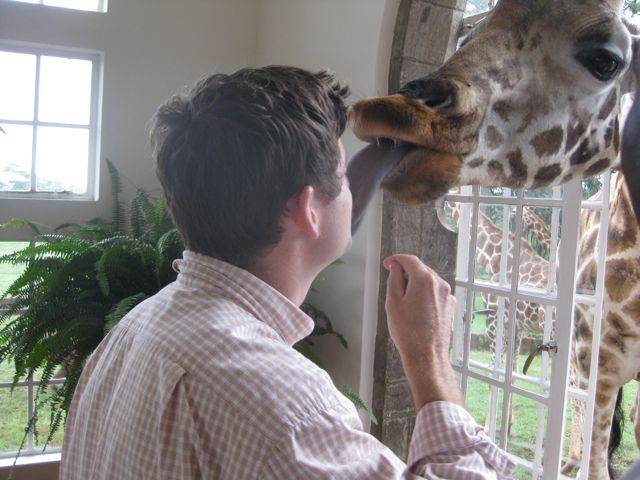
Not sure who first decided to see if they could kiss a giraffe, but we were encouraged to try it. All I can say is it's like taking a loofa sponge to your face, but instead of leaving your face smooth it's left really wet!  

Thursday, May 27, 2010

Sharon and David's wedding


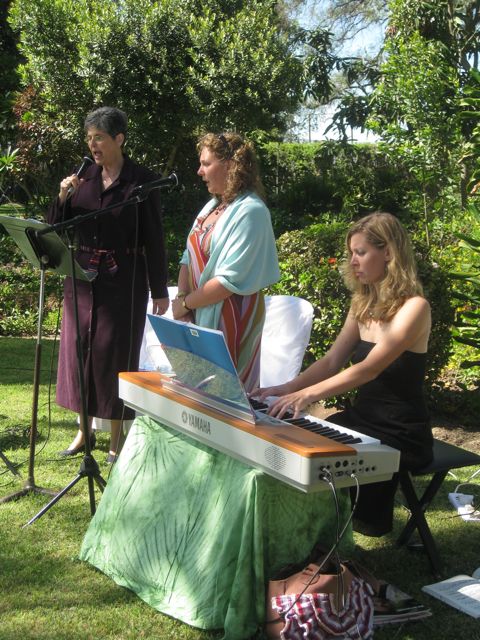
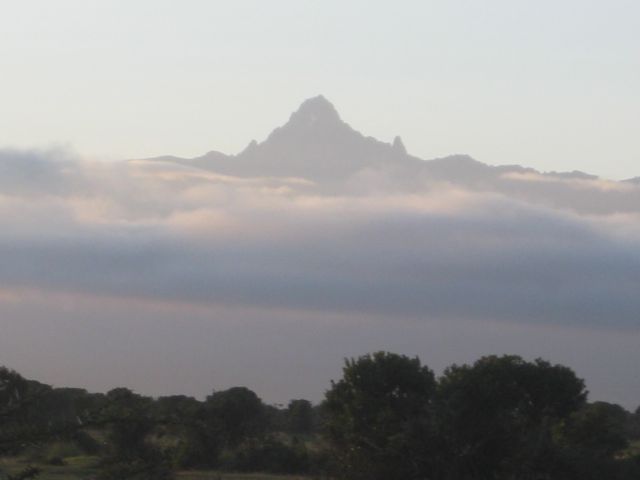
Sharon looked stunning coming down the aisle as I played Liszt Consolation no.3. David eagerly waited and they looked glowingly at each other the entire length of the Anglican service. The setting was at the base of Mount Kenya on a private game preserve and while traveling from the accommodations to the wedding lawn elephants, gazelle and giraffe were all spotted. Mt Kenya made an appearance which is incredible rare for May. (It was also incredibly rare to be attending a wedding on a Wednesday.) And we crossed the equator no less than 10 times driving to and from the reserve. It was a joy to be part of their celebration of marriage. Stephany, Sharon and I have done something together one night a week since August. We have become a sort of support group for each other. When the happy couple returns from their honeymoon in Zanzibar, we will only have one more chance for our weekly "meeting." And I will be losing my colleague. I admit that amongst all the celebration I couldn't ignore that loss and my tears were both of joy and sadness.  

Monday, May 24, 2010

When Can You Throw In the Towel?

When can you leave a job or a ministry? Are there areas that are not ripe for the harvest? What are legitimate reasons for "throwing in the towel"? Did Jesus ever give his disciples permission to simply move on? And how can we know what those reasons are?

The 10/40 Window has been one of the most successful and convenient marketing missionaries tools in the last 10 years. Who hasn’t seen a map of the 10/40 window? Guthrie in "Missions in the Third Millenium" writes:

The 10/40 window is an imaginary box drawn between 10 and 40 degrees of longitude, encompassing parts or all of 62 countries in Africa and Asia and a bit of Europe.... Some 3.1 billion people, approximately half of the worlds population live in the Window... This area is the epicenter to Islam, Hinduism, and Buddhism. 82 percent of the world’s poor live here. 29 of the 62 countries that have the lowest quality of life based on life expectancy, infant mortality, and literacy reside in the Window.

Despite the apparent emphasis on the 10/40 window...only 3 percent of the global missionary force is there and 0.01 percent of Christian ministry funds go here (We aren't there either, Kenya is south of the Window). That all makes me feel sad and guilty..like the Church has really misdirected many of its resources or that maybe we have been unwilling to go where we are needed most. Where it is hot, ruled by law of another religion, and potentially unstable.

I wonder what God would think about how our resources have been spread? Would God want a missionary to remain in an unreached area for several decades with no openness to the Gospel (but maybe seeds are planted)? Does God want more missionaries going to areas like Latin America where evangelical and protestant churches are exploding (but many of these populations have multiple chances to hear the Gospel in a meaningful way)? Does God need more ministers in Europe and in the City where churches are empty and Christianity is dwindling? Isn’t it just a matter of going where the most need is (when you lift a heavy log you go to the end where no one else lifts)? Can we distill the Great Commission down to a geographic window and some telling statistics?

I don’t know who can answer these questions. But I do think God would be saddened that there is still so much poverty, illiteracy, rape, hunger, violence, corruption, and despair in the Window. Also one wonders is the despair in the Window because these areas have not been reached by the transforming power of the Gospel?

Missions needs to go to these areas. But I don’t think guilt is the right response to get people there, or the right response if they go and do not stay. When Jesus sent out the 12 disciples he gave them few instructions (bring nothing but a staff and wear sandals). Jesus might tell his 12 disciples where to go, when to begin, how many people should go together, what should be preached, what activities to involve themselves, or even ultimately what was their purpose. But Jesus didn't tell them any of these things. Jesus gave them this final command.

And if any place will not welcome you or listen to you,
shake the dust off your feet when you
leave, as a testimony against them (Mark 12).


Jesus compels James, John, Peter, and so forth that if they are 1) not welcome or 2) not listened to they should leave. If you have come and spoken, but are not wanted or not heard... Jesus tells you to walk away. Am I suggesting we shake the dust off our feet at the 10/40 window, our churches, our jobs, our communities. Of course not. Blessed are the persecuted. His followers will be hard-pressed and afflicted. No, these places need determined missionaries, pastors, relief agencies, neighbors, friends. God's light needs to shine. They need His grace. But we must also reserve the permission and courage to leave when we are not welcome or heard; and then follow His will elsewhere.

Samaritan's Purse Today

News updates and blogs about how God is working through Samaritan's Purse and around the world.

Physical & Spiritual Healing (friess family--May 21, 2010)

http://www.samaritanspurse.org/index.php/Samaritans_Purse_Today/

Friday, May 21, 2010

3 Awesome Minutes

In case you are not a soccer fan; you may not have know that for the first time ever the continent of Africa will host the 2010 FIFA world cup. 32 teams including the likes of Nigeria, Cameroon, & Ghana will be converging in South Africa to compete for the World Cup Trophy. Africa goes mad for soccer and I am looking forward to being in Kenya when it happens.

Unfortunately no teams from East Africa (Kenya, Uganda, Tanzania) are represented. But I will be proudly cheering on the USA squad as they take on England in their first match June 12th. Being just a few countries geographically away from SA (tanzania, zambia, zimbabwe) it was tempting to get tickets. But it didn't happen. Anybody out there got an extra ticket to the World Cup?

Check out this three minute anthem to the 2010 World Cup...even if you don't know soccer superstars like Rooney, Ronaldo, and Landon Donovan you will recognize Homer Simpson and Kobe Bryant.

http://www.youtube.com/watch?v=idLG6jh23yE&feature=player_embedded

If this can't get you excited about the worlds most popular game futball, then nothing can.

Are Physical & Spiritual Healing Inseparable?

In 1974 the Lausanne Congress on World Evangelization declared, "We affirm that evangelism and socio-political involvement are both part of our Christian duty," thus emphasizing social ministry as an important part of missions.

Many Christians now stress Holistic ministry; that is evangelism and physical/social care go hand in hand. We encourage the connection of spiritual and physical, loving each other and sharing the good news, soup kitchens and proclaiming God's glory, health care for the needy and advancing the Kingdom of God. Franklin Graham has said, "Holistic ministry (Medical Missions) just plain works."

But the idea of holistic ministry was introduced far before this declaration in 1974. Luke 4:18-19 explains what Jesus was sent to do:

to preach good news to the poor.
He has sent me to proclaim freedom for the prisoners
and recovery of sight for the blind,
to release the oppressed.


Some say this (preaching, setting captives free, healing, and standing up for the oppressed) should be the goal of the church and the main thrust of missions (note; preaching the good news is included). Others stress that the Great Commission in Matthew 28 should be our thrust:

Therefore go and make disciples of all nations, baptizing them in
the name of the Father and of the Son and of the Holy Spirit, and
teaching them to obey everything I have commanded you.


That is (discipleship, baptizing, and teaching the Gospel) is our mission. In the history of Christianity we have seen the pendulum swing back and forth. Some time it leans too far towards social action (let's give food to the hungry healthcare to the sick, and fight for the oppressed but let's avoid words like Jesus or God's love; those terms are too loaded and controversial these days). Then the pendulum can tip too far in the other direction (The Bible tells us we will always have the poor with us. We can't get distracted by this world, we must focus on the next Kingdom. We just need more churches, more preachers, and more getting people saved.) These extremes are easy to recognize, but in real life I think missions and the role of the church is more subtle.

See how DeYoung writes:

When you love, you love the whole person, right? So why do so many churches seem disinterested in the human problems in their community and around the world? Didn’t Jesus heal the sick? Didn’t the Good Samaritan help the beaten man just because it was the neighborly thing to do? He didn’t give him a gospel tract first. Look, I’m in a city with crime, homelessness, poverty, broken families, and a failing education system. If we love God and we love people, how can we not care about these problems? Yes, I want to see people come to know Christ. People need the gospel more than anything else. Hell is real. They need reconciliation with God above all else. But they also need food and a job. Christians should care about these needs too. We are supposed to seek the peace of the city. Therefore, our vision needs to be bigger than providing a safe church for middle class people to have a safe experience of God so they can drive back to their safe neighborhoods and ignore a world of problems around them. The Bible has too much to say about loving the poor and caring about justice for us to simply save souls. Heaven is not a place for ghosts to fly around. It’s an earthly place with resurrected bodies where matter matters. We don’t reflect the reality of heaven if we turn a blind eye to the flesh-and-blood world in which we live.

and to the other direction:

Yes, we agree that the Christians should love people in word and deed. We too want to see our communities flourish. We think it is good and right to support relief work in Haiti or build an orphanage in Africa or repair a park in our city. But we are jealous not to lose or de-emphasize in any way what makes the church unique. The goal is not to make the world honor us for our good works, but honor God in their hearts. There are any number of institutions or humanitarian organizations or even members of other religions devoted to the problems of poverty and suffering. But what about eternal suffering? Who will give the perishing the words of life except the church? If we truly love people we will share the gospel and disciple them in Christ. Of course we want the peace of the city. Who wouldn’t? But biblical shalom is not simply human flourishing, it is also, and irreducibly, faith and repentance. There is no kingdom without worship of the King. Besides, we aren’t going to change the world or transform the culture, at least not by our efforts and strategies. It’s too complicated and we’re too ignorant. Only God builds the kingdom. The church is not the custodian of the culture. The church’s role is to be the church. This means preaching and sacraments, discipline and membership, and displaying a counter-cultural community. We’ll influence the world, but do so as we live our regular lives, pursue our specific vocation, and love the people as God puts in our path. So absolutely I want to help people. But the church can only do so many things. And the main thing we must do is testify to the work of Christ and raise up disciples of Christ.

The current trend is that churches and denominations are pulling a way from medical missions (a holistic ministry). Medical missions has been accused of forgetting the spiritual component of healing (we would say they are intrinsically linked). But I think sometimes they are right. We can get so wrapped up in medicine that we forget the main thing. You can see a lot of prescriptions, surgeries, and clinic visits at a mission hospital and sometimes very little open Bibles, praying, or preaching. There are many mission hospitals that have taken a slow decline to becoming just another hospital.

Is this lack of spiritual ministry intentional by missionary doctors and the hospital staff? Are they nominal Christians? I don't think so. Some aren't good multitaskers (I'm not good at taking a sexual history and transitioning into prayer). Some find it awkward (while we straighten your teeth lets straighten your walk with the Lord). Some are just too plain busy (with a Queue of 50 patients, a lecture to give, and hysterectomy on schedule.... trying to explain Salvation in another language is the last thing I have time for) . And language and culture are real barriers to sharing (even after being in Kenya over 19 months).

My observations are still optimistic. I see that holistic ministry is happening here at mission hospitals in Kenya (hospital wide but perhaps not doctor specific). The doctor may do the life saving surgery... and the chaplain is present to see a life reconciled by Jesus. A team approach: physical and spiritual healing inseparable.

Wednesday, May 19, 2010

Unfair


Have you ever seen a cuter girl than this (besides your own children)? Mom came to see us wanting to know if we could do anything to fix her smile.


Yikes! This is the same girl above. This is what Fluorosis can do to the teeth of the children here in Kenya. Excess fluoride in the water causes the staining and pitting of teeth as well as skeletal malformations in the legs. It is not her fault, she simply grew up in Nakuru where the water has naturally over 11 times the therapeutic amount of fluoride. It always makes me feel life is unfair.

I did find out from our missionary friends in Nakuru that there is a Catholic charity that makes fluoride filtration systems using crushed bone that are relative cheap (15 dollars) and last for years.

Tuesday, May 18, 2010

Scenes Around Kijabe Hospital


The black spots on the wall are Locusts that have invaded the hospital. They are attracted to light and it is really not possible in this environment to close all the outside windows. Fresh air is a necessity in the Wards. I'll just leave it at that.


We have been drenched with rain at Kijabe. God has opened the clouds like not seen in the last decade. It has made the process of converting the operating rooms a little difficult. This is the storage area... or perhaps where operating room tables go to die.


I call these guys the Kijabe Thrashers (sounds like a good name for a horror flick). But I always wondered why the hospital would not buy them a lawn mover or weed eater. Them someone said, "of course the hospital could buy a lawn mover..but then the Thrashers would not have job." So they keep thrashing away all month long until the weeds are shoulder high once again.


Then I found out many of the Thrashers are not paid at all by the hospital. They bag the grass and sell it has Cow Feed.

Monday, May 17, 2010

Meredith & Friend


This is really not her friend, but I figure I ought to write down a few of Meredith's funny phrases before she stops saying them and they are lost forever.

"How come when I get out of the shower, the air is all froggy out."

"Mommy, can we have chips and Brocomole?"

"I want to go to Naiwobi."

"When we go on Nafari, can we see the flamangoes."

she sings--
"Where is beautiful Mommy?
There she is.
God loves beautiful Mommy.
I do to. I do to."

Saturday, May 15, 2010

The best breakfast ever!


We were delighted to be invited to Giraffe Manor for breakfast. 


Their exclusive accommodations are the only location in the world to come-up close and personnel with the Rothschild Giraffe. It was such a treat to enjoy this breakfast and then be near the giraffes.
Particularly as this breakfast was a trial run of their new menu and therefore free of charge. It truly was a once in a lifetime event. Meredith and Amelia quickly overcame their fears and fed the giraffes for over 1 hour. While there were so many wonderful moments, the funniest moment was when I took Meredith to the restroom (keep in mind it is 880 dollars per night to stay here). She walked in and promptly said with genuine surprise, "Mommy it doesn't smell in here." I'm so glad she appreciates a clean toilet and restroom! And I'm not sure she would've learned this had we not lived in Kenya

Friday, May 14, 2010

A note of gratitude


Its not often in medicine that you find an encouraging note....


Dear Sir/Madam,


My name is M. from Mombasa Kenya.My wife S. was operated on at your premises in May 2010 for uterine fibroids.She was admitted and released.Her suregon was Dr.Sarah assisted by Dr.Sharon both of whom dis an excellent neat humane job and were ever ready to answer our questions.I was also very happy with the standard of care showed by your nurses among them the ever smiling Lucy,The efficent Josephine and others.Also to mention John of kitchen department who served very good food.

The hospital was also very clean and staff courteous and helpful.I would definetly recommend AIC Kijabe Hospital to my family,friends,colleagues.


Drs.Sarah & Sharon please accept my heart-felt thanks for curing my weife with God`s Help.May the healing of your hands continue to help many more people.


With Sincere Gratitude


M.

Wednesday, May 12, 2010

Endodontic Referral

      This is interesting to me (may be quite boring to others) but I know a few dentists log on here from time to time.  This man was referred to our clinic with these x-rays in hand wanting to know if we could "guarantee" that we could save his 2nd Molar.


    Mesial and distal canals seem straight but canal space disappears as you move apically.  You can see a distal apical RL.  Distal canal was accessed by previous dentist and filed to near WL.

Oooops. Hand file perforation into the furcation by previous dentist when searching for mesial canals.  But recognized and patient was appropriately counseled.  

   Perforation repaired with amalgam.  Still unable to gain access to mesial canals.  To answer the patient's original questions (Can it be saved).... no guarantees were made, except our best effort.

Kijabe Matatu Service

      Amelia is the driver and Meredith the captain.  

Tuesday, May 11, 2010

Locusts


And the LORD said to Moses, "Stretch out your hand over Egypt so that locusts will swarm over the land and devour everything growing in the fields, everything left by the hail."  So Moses stretched out his staff over Egypt, and the LORD made an east wind blow across the land all that day and all that night. By morning the wind had brought the locusts; they invaded all Egypt and settled down in every area of the country in great numbers. Never before had there been such a plague of locusts, nor will there ever be again.  They covered all the ground until it was black. They devoured all that was left after the hail—everything growing in the fields and the fruit on the trees. Nothing green remained on tree or plant in all the land of Egypt. (Exodus 10)
I don't even know if these bugs are Locusts.  Maybe a biologist out there can identify this green thing.    But whatever these palm-sized grasshopper look-a-likes are called they have infested our house and Kijabe in general.  OK is not quite a Biblical Plague, but these beady eyed green long-legged critters have found their way into our bathtub, bed, Mocha's doggie bowl, towels, the dental clinic, the back of our car, and on Meredith's baby doll (which she found very scary).