Thursday, March 25, 2010

Fried Flying Ants


Amelia and Abby brought flying ants home from school (just two) with idea that they could be fried and eaten. Apparently some tribes in Kenya eat flying ants on a regular basis. First Amelia and Abby removed the wings.


Two flying ants being fried with butter. How do you really know when a flying ant is completely fried?


Flying ants ready to eat.


On the fork and into the mouth!


The surprisingly positive reaction to the taste of fried flying ants.


Well, the pictures about say it all. I don't know if I should be more surprised that Amelia wanted to try eating a flying ant, that she said it tasted, "good, like bacon," or that Malin knew enough about cooking to fry it in butter.

Wednesday, March 24, 2010

Intrusion


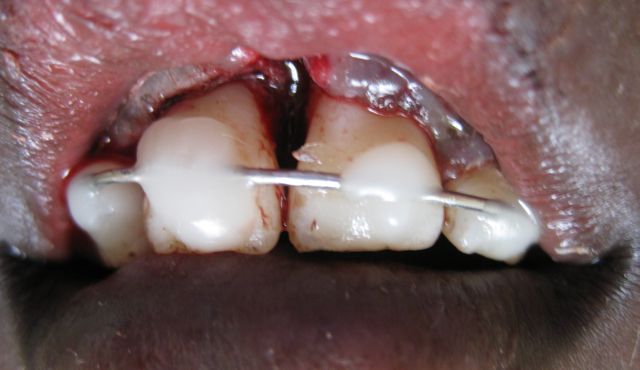
This 8 year old boy was scared to see me after falling on his face on the way home from school. Believe me, I'm often just as scared of these little patients as they are of me.


Intra-oral x-ray shows intrusion of both central incisors (note discrepancy in position of central incisor edge to lateral incisor edge). Apices seem 90 to 100% formed so repositioning, splinting with composite and SS wire, Ca-OH pulpotomies, and eventually RCT was our planned treatment (96% of teeth with intrusion injuries will become necrotic). Note tooth #9 seemingly with its apex pushed into the nasal space. No root fracture is seen.


You can see the aftermath of the accident. There should be as you know be two teeth nicely with their natural crowns exposed. You can see both teeth intruded well into the gingival tissue. Diagnosis of intrusion greater than 6 mm indicates surgical repositioning.


After a lot of tears, some screaming, and a very unhappy little boy the teeth were repositioned and splinted. Next up the pulpotomies in a few weeks. I hope we become friends by then.

Monday, March 22, 2010

Eiffel Tower


No we are not in Paris. We are still in Kenya. I've never visited the Eiffel Tower on the Champs de Mars but according to Amelia this is what the 19th century iron lattice tower looks like if it were made of string.

Saturday, March 20, 2010

How to create "Killer Community" anywhere!

Maybe some of you have been involved in some "killer community" small groups within your church, college, or circle of friends? When a small group has good chemistry the results can be remarkable. Weekly time together is anticipated, strong friendships develop, healthy community prayer practices emerge, corporate faith grows, and ultimately in a gathering as such I believe God is glorified.

Maybe you also have been involved in a small group community that was far from “killer” and just needed to be killed. If you are lucky these groups quietly and hopefully rapidly disperse and disintegrate. If you are not so fortunate these groups painfully endure week after week. Meetings are avoided, conversation is awkward and forced, and the whole thing seems like work instead of spiritual refreshment.

It is clear that God calls us to gather together in community (Zep 2:1). Something special (including prayer, companionship, vulnerability, accountability, God’s word is opened, to name a few) occurs when people make time for God by making time for each other.

Within Kijabe Hospital, Moffat Bible College, and Rift Valley Academy (all three within walking distance) there are probably upwards of 150 Missionary Units (families, couples, or singles). A missionary community this size brings with it the blessings of diverse resources, a dynamic atmosphere, a school for our children, and a strong corporate community. The downside of a community this size is the real possibility of feeling lost. Maybe you have been in community without having community in your church, workplace, or school?

Community rarely just occurs spontaneously. It seems to take a mix of commitment, time, intentionality, and simply making meeting with others a priority. We have been blessed by a gathering of five families that started at the beginning of the year. We find childcare while the adults gather for prayer and study. Shortly after that, the kids return and we conclude with music and dinner together. Is it working? I think so. The attendance is consistent, the meetings are anticipated, and most importantly I think we acknowledge our reliance on God and each other.

I don’t know what makes one small group “killer” (which is uplifting) and another small group “needing to be killed” (that’s OK also..many things God has a season for). But I know God would believe it is worth trying.

The following short humorous video clip is well worth seeing!

http://www.ignitermedia.com/products/iv/singles/1379/Killer-Community-Tips

It is Jonny and Chachi’s invaluable “advice” on how to experience community at its finest. Let me know what you think.

Thursday, March 18, 2010

"The World's Worst Country"

Have you read the awards for best city in America to live in and they come out with towns like Kalispell, Montana, Ft. Collins, Colorado, or Amelia Island, Florida. I've never seen the opposite list of most down-and=out towns in America (Detroit, Michigan, Youngstown, Ohio, etc). But recently the Economist came out with an award for the world's worst country in the year ahead (2010).

They say, "calling this country is a stretch. It has a president, prime minister, and a parliament but with little power outside their capital city. Even their presidential palace requires an outside peacekeeping force to protect the president. In this country more than 40% of the population need food aid to survive and one in every 5 children is malnourished. 1.5 million people live in dire, temporary camps. The future of this country is bleak. The country has a meager economy, and the aid that has been promised often can not get to the people who need it because security can not be guaranteed."

Residents of this country come to Kijabe Hospital frequently for care. I am told this people group is amazed at how quiet the hospital is without the noise of any gunshots or explosions that they are accustomed to hearing back home. Their greeting I have learned is Nabut Mia. This translates to 'is their peace'...that being the first thing they ask anyone they meet. The only history they know is instability, fighting, violence, and civil war for the past 20 years.

I don't write this to knock them down...but to recognize what an opportunity we have at Kijabe to have them come to our hospital. Inside they are likely broken, fearful, and uncertain about their future. If you have not guessed which country this is...the dubious honor of world's worst country goes to our neighbors occupying the Horn of Africa...Somalia.

Tuesday, March 16, 2010

Do I look different?

It wiggled for days and days and even though Daddy is a dentist..this 6 year old patient would not let him extract her front tooth. It finally came out at school and was brought home in an envelope. I think Amelia looks like a Hockey Player.

If you ever listened to Marv Albert the announcer for the New York Knicks NBA team you would have heard his emphatic, extended trademark phrase of "Yessssssssss!" Meredith has picked up that phrase in her everday life.
"Daddy can I have Rice Krispies? Yesssssssss!"
"Mommy, can I sit in the front seat of the car? Yessssss!"
"Sister, can I use the pink crayon? Yessssssss!"

Monday, March 15, 2010

Florence


We (myself and my father) operated on Florence in December to remove a low grade mucoepidermoid carcinoma (minor salivary gland tumor) of the hard palate.


The tumor covered 75% of the hard palate and to remove it we stripped the mucosa off leaving raw palatal bone. After seeing her 1 months later I was concerned that the tumor had reoccurred. There was bleeding, raw palatal bone exposed, and very slow healing. You can see the original excisional biopsy specimen above.


When I heard Florence was here at Kijabe Dental again for her reevaluation I was dreading seeing what her mouth would look like. I was expecting bleeding, poor healing, and the necessity of a rebiopsy to check for reoccurrence or her cancer. But to my surprise the palate was now covered with healthy, pink, firm, stippled gingiva, and no signs of cancer.

alt=""id="BLOGGER_PHOTO_ID_5448352135954426290" />

Florence as you can see was pleased as was I.

Sunday, March 14, 2010

10 Things We Miss About Home

I like lists. I’ve written a list of 50 things I want to do before I turn 50. I’m currently reading a book about lists (Checklist Manifesto by Atul Gwande) and how lists insure things are done right (maintaining safety in take-off of a Boeing 757, building a 80 floor skyscraper so it won’t fall over during high winds, placing central lines with low infection rates). I put lists around our dental clinic to remind our staff where things go, when things are to happen, and who is coming.

But I hesitate to write a list about missing...because it quickly transforms from what I miss (family, church, etc) to a pity story and/or complaint machine (bad African roads, inferior medical instruments breaking down, developing nation infrastructure, etc). Woe is me! I also wanted to wait until we lived in Kenya a substantial length of time (now 17 months) to figure out what I really missed (family) and things I could live without (Cinnamon Toast Crunch). I hope this list will share what we miss (because they are important parts of our life) and not come across as critical to Kenya, its people, or culture (We are blessed to be here with these good people). So here are the 10 things we miss about home in no particular order.

10- We miss the freedom to travel at night. Roads are not marked and cars often have one working headlight...that single headlight approaching may not be a motorcycle but a Lori (I also saw a motorcycle driving by flashlight), and bandits are about... it’s just not safe to drive at night. Where would we go if we could? Maybe a movie, a coffee shop, a book store, or out to dinner..with the girls falling asleep in the back in the dark on the way home and Sara and I talking.

9- We miss the seasons. The weather is 50-75 degrees daily, usually sunny, probably a lot like San Diego. The sun rises EVERYDAY (along with Meredith) at 6:15 AM and sets EVERYDAY at 7:15 PM (we are within driving distance of the equator). I could not tell you when the best month to harvest corn or plant tomatoes is and they may be the same month for all I know! The weather is so regular around Kijabe it can get a bit monotononous! What seasons do I miss?

We miss the authentic Autumn of Ohio with school resuming, the excitement of College Football, pumpkins on the porches, piles of leaves blowing down our sidewalk, the reds, yellows and orange of the Cuyahooga Valley National Park blurring together.

We miss the winter of Central Oregon with white snow, x-country skiing to Tumalo Falls, Christmas Lights, a warm fire at home, nice turns on the Outback lift at Bachelor, and a Fir Christmas trees that smells everything like Christmas should.

We miss the Spring in Portland and Seattle as the Crocus peak through even in late February, the blooming house size Rhododendrums, the scent of NW coffee (even though I don’t drink coffee), hiking in the Old Growth Forests, and wearing a Gortex coat in lieu of a umbrella like any proud Northwestener would do.

We miss the summer of the Puget Sound as the Ferries are passing by, the lakes are prime for water skiing and swimming, the ocean is alive, the daylight that extends just when you need it most to get in that last bike ride, jump shot, or walk to get ice-cream with the girls.

8- We miss our country. I didn’t expect this at all until we were at a conference about reverse culture shock and it was suggested that when repatriating strong emotions, tears, and love for your home country can emerge; and I realized I hadn’t seen our flag or sang our national anthem in over 16 months (this also coincided with the Winter Olympics). I became sad and proud of the USA at the same time. I wanted to pledge allegiance, sing the star-spangled banner, and read the Declaration of Independence all at once. Without being ethnocentric, jingoistic, or any other ‘ic’ I have become even more aware that the United States is strong, generous, honest, free, and amazing country to call home. I’m more proud to be and American citizen living in Africa than I ever have been before. I’ll leave it at that.

7- We miss the American health care system. I know the system in America has faults. I know health insurance is expensive. I realize too many people that want to be insured are not. But once you have a condition that requires surgery in a third world setting...you will yearn for any City Hospital in America compared to the best hospitals here (no criticism intended) in Africa. We have missed the nursing care, specialization, privacy, competency, compassion, cleanliness, and excellence that the American Health care system provides.

6- We miss not being with family and friends when they need us. We are sorry! We feel helpless here when back home someone we know has open heart surgery, misses out on job sorely desired, is working things out in a new relationship, faces an unknown future of transition, has health problems, is in the hospital for pre-term labor, is redefining family, is fired from a job, has a big test, is being scrutinized, has lost their house, lost a family member, has problems with their children, isn’t being heard, wonders where God is right now. All of this and more has happened to family and friends since we have been gone. Skyping, e-mail, blogging, and mobile phones are great inventions but vastly poor substitutes for a hug, prayer, shared tear, a word of encouragement, or a cup of coffee together. We are still praying for you. Thankfully, there are no physical boundaries that prevent God’s ability to answer prayers.

5- We miss being with family and friends during the great times. The other day Meredith said, “Daddy I miss my cousins.” I wondered which cousins she was talking about as she now has 7 cousins (two new since we have left) and two other we have met just twice. The little ones (cousins and friends) are growing and we have missed countless birthdays, 2 Christmases, wedding, new births, Summer Reunions, graduations, and much more. I have heard of missionaries that have prayed that “God would take their longing for their families and friends away, to help them better serve without distraction.” Hey, we have been blessed with great friends at Kijabe and Tenwek...but our thinking is not in that camp! Our friends and family back home (YOU) are irreplaceable. And though we know the party must go on without us...we think it would be a much better party with the Friess Family present!

4- We miss being connected. They say a missionary is at best at least a season behind and at worst forever stuck in the year they went out on the mission field. That either means we are still living in 2008 (I think ‘W’ is no longer President) or at best somewhere in the spring of 2009. Occasionally I see Western visitors coming wearing rolled-up pants, big sunglasses, loafers, v-neck sweaters, collars up, and bigger hair than I am used to (is this the 80’s again)....and I wonder why are they dressed so differently? But it happened so consistently I finally realized no Malin...you are the one that is out of style (which is no big suprise). If I could just find my pegged pants, hairspray, and Izod shirts from 8th grade!
We missed celebrating together as Americans the Winter Olympics Gold Medals and Inauguration of our new President. Just the same coming together for the Relief in Haiti and even the downturn in the economy and just trying to understand the implications of the health care reform.

3- Can we each have a few superficial things we miss? Chipotle Burrito (black beans, cilantro, white rice, beef), a smooth road (for driving or cycling), street lights, pop tarts, Philadelphia Cream Cheese, Cosco, March Madness, Borders Books, Nightly News, NBA Playoffs, and reliable internet.

2- And for Sara (a bit more refined)? Starbucks Coffee with friends, the convenience of Target, Panera Bread, a flat trail in which to run, NW Seafood, a great salad, and the Fine Arts (Broadway Musicals).

1- We miss our home churches? We miss worshiping with you through good music, engaging bible study, challenging sermons (Our home pastors are great and most any sermon they give could satisfy the 3AM phone call rule..Pastor what is your sermon about?...and they could give you the answer in one concise sentence!), and most of all your friendship. You are indeed glorifying God in how you worship. And also glorifying Him in your support of our family in Kenya.

Being called to be in Kenya now feels right, different, and far away from home all at once.

Thursday, March 11, 2010

Why we do what we do...

There are many bad reasons to be a missionary; the desire to hide-away from Western Culture, because my parents were missionaries, I don’t know what else to do, I don’t get along with my family, I don’t fit in back in my home country, I want to be known as a missionary, I want to own a big safari truck and drive fast on dirt roads, I want to be a minority, or because it is legal here to have more than one wife.

There are many good reasons to be a missionary; the desire to travel to new countries, to experience other cultures, to identify with people different from one’s self, to give back to the poor, to build churches and houses, to bring clean water to the thirsty, to provide healthcare to the poor, to teach a language are just a few good reasons that come to mind.

But I am convinced there is only one great reason to do missions. This reason looks at the motivation behind why any missionary does what they do. In the book ‘When Helping Hurts’ authors Corbert and Fikkert write...

“What truly motivates you? Do you really love poor people and want to serve them? Or do you have other motives? I confess to you that part of what motivates me to help the poor is my felt need to accomplish something worthwhile with my life, to be a person of significance, to feel like I have pursued a noble cause...and in the process, I sometimes unintentionally reduce poor people to objects that I use to fulfill my own need to accomplish something.”

I know myself am guilty of motivations that are not particularly wrong (I want to live a meaningful purposeful life)....but also are not as pure as I would want them to be (I help because I care). Can I turn my motivations away from fulfilling my own needs to accomplish (not a terrible thing) to loving the people I am serving (a much better thing) on my own?

Paul writes to the Church of Corinth...

If I speak in the tongues of men and of angels, but have not love, I am only a resounding gong or a clanging cymbal. If I have the gift of prophecy and can fathom all mysteries and all knowledge, and if I have a faith that can move mountains, but have not love, I am nothing. If I give all I possess to the poor and surrender my body to the flames, but have not love, I gain nothing.

Only the love and forgiveness of our Redeemer Jesus Christ can transform my sinful heart (which even when helping those in need is misdirected by selfish ambitions) to something new and pure (simply loving those I am with).

Wednesday, March 10, 2010

SORRY


Amelia's favorite game. We play over and over and over. And while the game teaches to say, "Sorry," it does so while you are intentionally making the other person lose. There's something sort of wrong about tritely saying, "Sorry," and making the person start over time and time again. But wait the opponent also gets to smile and say, "Sorry," as your player goes back to start. Has anyone else ever been bothered by the lesson taught in this game? It seems to teach: say "sorry" and you can do anything you want to the other player!

Alright maybe I'm taking the game to seriously or just trying to find an excuse not to have to play again!

The encourager

Whenever I've taken a spiritual gifts assessment, the gift of encouragement is always on the list, but never by my name. I admit I find it hard to "encourage." It's much easier for me to be analyze, try to improve, critique and yes sometimes be critical. But I see in Meredith the very thing I find hard to do. At dinner, "You make the best soup ever mommy." At bedtime, "You're the best mommy ever and you're mine." At breakfast, "I love to wake-up and see you mommy." During the day, "You're my favorite mommy, when I grow-up I'm going to be a mommy like you." "Mommy you look pretty." "Mommy, I like how you painted your toenails purple." And it continues talking on the phone with Nana and Papa, "Nana, you're the best Nana ever. I really miss you." To her sister after falling, "Sweetie you'll be okay. Let me help you." Okay, you get the point. She gives more encouragement in 24 hours than I usually give out in a month. Hebrews 3:13, "Encourage one another daily, as long as it is called today, so that none of you may be hardened by sin's deceitfulness." I pray Meredith will always be quick to encourage and that I will be quick to encourage others as well.

Sunday, March 7, 2010

Growing


This is the mother I wrote about in December who finally gave birth to a live little girl after losing 2 babies at term. She called me to show-off her now 5 kilo girl. I had been praying that this child was growing well after she had come in with a sodium of 218
10 days after birth. For those of you that don't know much about sodiums this level means severe dehydration and high risk of neurological impairment not to mention the possibility of imminent death. But God was gracious and it was a joy to see them both!

Friday, March 5, 2010

RPC


Our patient I will call 'M' has lived with the defect of unilateral cleft lip and palate since he was born 10 years ago. It is disfiguring, causes difficulty chewing, makes pronunciation of words nearly impossible, and forces M to live with a chronic sinusitis and runny nose as the nasal turbinates are directly exposed to the mouth. Despite this M is seen on the playground adjacent to the pediatric ward with a gigantic grin as he comes down the slide.

M was referred to dental after an unsuccessful surgical attempt was made to close the lip and palate (the wound dehisced and separated). A second surgical opinion thought the distance (probably 10-15 mm) was just to severe to achieve a successful union of the lips and covering of the palate.


Winnie taking an impression on M for a perhaps a newly invented appliance we are calling a rapid palatal condenser (RPC).


You may know about the traditional appliance the Rapid Palatal Expander (RPE) or better known as Hyrax if you had orthodontics as a child and suffered from a posterior cross bite. The RPE consists of a screw attached to the posterior teeth. The device is designed to break the palatal suture of the developing child in a short time period. With each twist of the screw over a two week period the device separates .25 mm and the teeth begin to move laterally into their correct position. Some feel the RPE is more of torture device because it causes pain (even a sound as the boney palatal midline suture breaks), headache, and gap in between the upper central incisors with each twist of the screw by their parents.

We reasoned that if you can use a RPE to expand the palate, why not use a RPC to bring a cleft palate and lip together.


You can see the appliance above cemented in place. We are giving it a few turns of the screw each day to see if we can achieve sufficient closure that M can go for surgical repair.

Wednesday, March 3, 2010

Your Generosity Has Done This...Part III


Rose works as a unit clerk for ENT and became a good friend in the past 4 months.


In October a gas burner caught fire in her home. In less than 5 minutes this was all that was left of her timber house and the homes of eight others. Rose and her husband got out safely but lost everything they had.


The hospital set up a fund to rebuild Rose a temporary house which you can see above that she moved into last week. I told Rose that we had many generous people back in America who were supporting God's work in Kenya. These people wanted to help someone who is in need and trying to rebuild, I asked her if there was anything she needed. Rose told me that they needed a simple bed and mattress.


Because of your generosity funds were used such that Rose and her husband have a place to sleep at night. Asante Sana!

Tuesday, March 2, 2010

A mini safari


Just a couple pictures from our visit to Lake Naivasha yesterday. We saw lots of birds, water buck, giraffe, hippo and zebra. Only a 40 minute drive from Kijabe. It was good to see all the rain had raised the level of the lake; although more is still needed. Meredith has enjoyed all the attention. Amelia wanted to skip school yesterday "so I can be with Nana and Papa," tempting offer, but in the end decided it was best for her to go! So she called at lunch to say she had a "bad headache" and needed to come home. I told her we were at Naivasha and that she should go to student health. Her headache improved as she remembered it was computer class in the afternoon.

Monday, March 1, 2010

Mom and Dad arrived

We were glad to see Nana and Papa at the airport Sunday morning. After sorting out the luggage that didn't arrive, we went to Java House for breakfast and then headed back to Kijabe. They managed to mostly stay awake until dark (7pm)! It's good to have them here.

Saturday, February 27, 2010

Samaritan's Purse Post Residents Visit Kijabe


Bottom Row (left to right) Dr. Cropsey (Op), Dr. Friess (DGP), Dr. Cichowski (OB/GYN), Dr. Hawk (PED)
Top Row (left to right) Mrs. Shirley (Nurse), Dr. Francis (OB/GYN), Dr. Fader (Gen-SUR), Dr. Mclaughlin (FP)

Friday, February 26, 2010

We've Been Flashed!

Driving in Kenya at night is to be avoided at all costs and now we know why. Last night we got behind schedule and drove the last 30 km up the Rift Valley to Kijabe Hospital in the dark. The picture to the right assimilates our vision of oncoming traffic.

We learned three things about driving in Kenya in the dark. First, painted lines to identify passing lanes, shoulders, medians, the center of the road are non-existent or too washed away to see. Second, checkpoints where police stop traffic to check cars for proper markings are marked with one small dim kerosene lamp. Third, there is a pattern that as you approach oncoming traffic it is expected to "Be Flashed," that is to blink on your high beams until you pass the oncoming traffic.

Thankfully we are home safe..and will now make every effort to avoid Being Flashed at night again.

Wednesday, February 24, 2010

Being 3

Our 3 year old daughter Meredith has hit that unique moment in life when she has the words to express a wide range of emotions, matched with the impulsivity to melt down into a pool of tears in an instant. Some of her new favorite phrases...
I don’t want to talk about it.
That is totally not fair.
Ha-ha I said stinky.
I'm having a sad day.

Some of the rules we have recently set for Meredith.
Meredith stop licking the salt shaker.
Meredith stop drinking the bath water.
Meredith stop biting Amelia.
Meredith no washing your hands in Mocha's water bowl.

Meredith can then redeem herself with moments prior to falling asleep where we have had the following conversation...
Daddy you are a good daddy.
Daddy, only you can be my daddy.
Daddy, I don’t want you to die (I think that one is a complement in a 3-year-old sort of way).

Tuesday, February 23, 2010

Course of Treatment

July 8, 09 35 YOM presents to dental clinic (no significant medical history, otherwise healthy, no allergies) with “swelling on right side of the face and trismus. Unable to do intra-oral examination. Referred to Kenyatta National Hospital.”


August 1, 09 Dx- Trismus, Periocoronitis secondary to impacted #32.
Plan- Take to Surgery for GA (because of trismus) and surgical removal of impacted #32.

August 3, 09 Kijabe Hospital. Consent, GA, Throat Pack placed. LA, Buccal Flap raised adjacent to #32. #32 Sectioned and removed completely without incident. 3 Chromic sutures to close. Rinse with sterile saline. Throat pack removed. Patient awake with out adversity.
Rx- Pen V-K, Paracetamol, Ibuprofen

August 10, 09 Healing WNL. No signs of bleeding, pus, or infection. Trismus still present (opening of 10 mm). Encourage physiotherapy with finger excercises.

October 12, 09 Painful swelling on right side persists. Masseteric Space infection. OPG and PA shows no residual root tip.

October 21, 09 Patient reports abscess draining intraorally (distal to #31). #32 socket not completely closed. Rx- Amoxicillan, Flagyl.


October 27, 09 Pus still draining distal to #31. Limited opening still at 10 mm. OPG taken..poor quality. Rx- Augmentin

November 11, 09 #32 Socket now healing. Trismus still present and swelling masseteric space (painful to palpation). Rx- Chlorohexidine Mouthrinse BID and finger exercises to increase opening.

December 10, 09 R side Masseteric Space swelling decrease in size, Max opening improved to 20 mm. No visible pus. Saliva normal flow and volume. Rx. Ibuprofen.

January 13, 10 Swelling reoccurs on R side Masseteric area. Pus discharge distal to #31. Opening decrease to 10 mm.
Tx- Curetted area distal to 31. No bony fragment, cyst, or tooth roots removed.
Intra-oral and extra-oral aspiration attempted but with no aspirate achieved.
Plan- refer to KNH for better imaging.


February 21, 2010 Patient returns with OPG (good quality). Shows mixed RO RL area in R condyle tracking near the IA foramen. Masseteric space infection increased in size and painful to palpation. Pus still draining intra-orally.

Monday, February 22, 2010

Dentistry's Workhorse

Although I would like to think that as a missionary dentist I'm always doing something dramatic like fixing a broken mandible, doing extractions in the Bush, or rescuing a teenager who avulsed a central incisor; the majority of my time is doing the same thing I would be doing back in the United States; good old fashioned class II amalgam fillings (dentistry's workhorse) to treat inter-proximal decay.


Amalgam fillings have a longer and seemingly more derogatory rap sheet than Mike Tyson, Dental Amalgams have been blamed for almost everything including Autism, Alzheimer's disease, Meniere's Disease, Multiple Sclerosis, Arthritis, Alopecia, Tennis Elbow, and probably even Athlete's Foot. It doesn't really matter how many studies have shown that Amalgam is safe, junk science seems to predominate. It doesn't matter how many case studies show that after removing dental amalgams neurological disorders fail to improve (there is always one vocal person who swears by this treatment). It doesn't matter how many materials experiments show that the mercury in amalgam form is inert, OSHA is making it more difficult on our profession to use this material (even though the risk of mercury is much greater from eating fresh Tuna Fish than from amalgam fillings.)


Now I'm first to admit these fillings are neither sexy, fashionable, and/or state of the art. I completely understand that many who have the time and budget are going to prefer white fillings on there back teeth. But dental Amalgam has been our profession's workhorse for the last 150 years. There benefits are many including strength (withhold chewing forces), long lasting, self sealing, easy placement (able to be placed in a wet field), relatively quick placement allowed (good for children), and lastly are relatively cheap. In the end in Africa these restorations are appropriate, cost effective, and serve the community at large very well. I have amalgam restorations in my mouth and they will remain. And, after a quick polish they don't look too bad.

Sunday, February 21, 2010

The Obama Conga

Even as President Barack Obama's approval ratings decline in the United States he remains very popular in Kenya. President Obama's ratings in Kenya hover at around 94%. Obama chewing gum, Obama conga's, and Obama t-shirts can be found at about any rural Duka.


The Obamas are member of the Luo tribe; Kenya's third largest ethnic group. President Obama's father was an economist in Kenya. It seems that nearly everyone you meet is somehow Obama's "cousin." And I have been told that "President Obama is currently Kenya's honorary second president."

Saturday, February 20, 2010

Butterfly Hospital


After learning about Monarchs (which mean King) and chrysalis at school Amelia took to our neighbor's backyard to find, catch, and capture butterflies.


Amelia and Meredith began to notice many of the butterflies they found had damaged wings. They decided it was time to build a Butterfly Hospital to help rehabilitate these insects. I asked Amelia how the healing was going, "Daddy we have almost healed one butterfly. We raise them up on one finger so they learn to get air under their wings again."

Thursday, February 18, 2010

CMDA Brankenhurst Conference 2010

The past two weeks we joined over 250 missionary doctors, dentists, nurses, and community health workers from all over the globe at Brankenhurst Conference center for the 2010 Christian Medical & Dental Association African Conference. Joining us were over 60 lecturers from Mayo, Hopkins, Brown, Cleveland Clinic and other institutions throughout the West.


The conference serves three purposes. The first is to provide Continuing Education such that missionary doctors can retain their current licenses and remain up-to-date in the ever changing fields of medicine in their particular specialities without having to leave Africa. Throughout the two weeks Sara and I received combined nearly 90 CE hours (more than enough to retain our current State License) and we completed ACLS certification (of which Sara beat me on the test 96 to 88...I'm humbled once again by my wife). Sixty percent of the lectures are geared toward Western standard of care.

The second purpose is to provide educational topics that are relevant to doctors often working in high need and resource poor areas. Just a sample of the lectures included were sustainability in mission hospitals, dental extractions for the non-dentist, management of snakebites, effects of mobility on missionary kids, Help! my patient has a syndrome, culture shock; coming and going, traveling with infants and children, prevention of maternal to child HIV infection, and mandibular fractures workshop. Forty percent of the lectures are geared toward care in a resource poor area.

The third purpose is to provide professional and spiritual encouragement by gathering together and sharing our common challenges we face as medical missionaries.

The dental missionary community is small group and not well connected. I met a Bush dentist in the Horn of Africa who works with portable equipment in 130 degree heat. I met a dentist in Senegal who in 3 years has developed a full dental curriculum and fully trained nurses to operate a dental clinic. Sara and I ate lunch with an Oral Surgeon and his wife who served as a missionary in the first Dental School in India and is now coordinates heavily with CMDA and Project Med Send. I was able to pepper Oral Surgeons from the UK and Ohio State who serve on Mercy Ships in East Africa with questions regarding treatment of mandibular tumors and fractures. Our lectures (who donate their time, and travel costs) included OMFS, endodontist, and prosthodontist.

Sara gathered with other OB/GYN post-residents Sharon and Christina to find a cardiologist to help with treatment of cardiac disease in the pregnant patient. They had a long lunch with an MFM doctor to talk about treating high-risk perinatal patients in the maternity ward. They were able to talk about the ethics and management of treating infertility with a REI doctor.

We were encouraged and challenged by our lecturers and missionary colleagues around the world. Thanks CMDA for an excellent conference.

Wednesday, February 17, 2010

A mile wide; an inch deep

A description be it fair or not of the African Evangelical Christian Church is that the Church is like a lake that is a mile wide but an inch deep. The lake is a mile wide because a large majority of Africans would claim Christianity as their religion. 80% of Kenya claims to be Christian (remarkable considering at the turn of the previous century that percentage was less than 2%). There are Christian churches of most all types (gospel churches, pentecostal, reformed, bible churches, liturgical, etc.). Even the smallest villages usually have a Christian church and a lay pastor.

The accusation that the African church is an inch deep points I think to a perceived shallowness of theology, lack of discipleship, and marginal commitment of faith. But is this a fair assessment of the African Church? And who is to blame? If missionaries largely planted the churches in Kenya...is it the fault of their church planting strategies, their portrayed message (Western Theme), their discipleship, their taught theology? Yet missionaries in the early 1900’s literally risked their life to come to Africa..some were told to bring their coffins along (statistics showed that 1 in 3 did not return). It is through their courage via God’s grace that any form of Christianity caught on and the African church grew.

Some might say that the Gospel message in an African context somehow simply got lost. Some would criticize the church of legalism and moralism as issues of drinking, adultery, church attendance, and tithing are over consuming. Others might criticize the church of reductionist theology..your in, your out... saved, unsaved...with little interest in discipleship, caring for the poor, or evidence of fruits of belief.

The African Church just like the Church in the West I believe needs to acknowledge that the Lake is very very deep. We often linger near the shore wading in the shallow end without daring to go beyond where we can no longer touch. Look at Paul’s writings to Thessalonica with a strong emphasis of being ‘chosen’ by God:

For we know, brothers loved by God, that he has chosen you (1 thess. 1:4)
But we ought always to thank God for you, brothers loved by the Lord, because from the beginning God chose you to be saved through the sanctifying work of the Spirit and through belief in the truth. (2 Thess. 2:13)

as compared to the Gospel of John’s emphasis on ‘belief’.


Yet to all who received him, to those who believed in his name, he gave the right to become children of God. (John 1:12)
For my Father's will is that everyone who looks to the Son and believes in him shall have eternal life, and I will raise him up at the last day. (John 6:40).

This relationship of election and belief along with the Trinity, the Incarnation, Original Sin, the Cross are all incredibly challenging concepts to grasp and assimilate. But we must seek to do this through study, fellowship, education, podcasts, communication, prayer, etc. Indeed, today in a perhaps post-modern culture there is more urgency for all of God’s church to become a mile wide AND a MILE deep.

Tuesday, February 16, 2010

Getting together


Sharon (OB with me at Kijabe), myself, Stephany (pediatrician at Kijabe) and Christina (OB at Kapsowar) have enjoyed spending time together during the CMDA CME conference. We've shared some meals, walks, movies, lattes, and even a day shopping together. We've also talked about some of the unique challenges we have a female physicians and at the hospitals we work at. But more often we've talked about Sharon's upcoming wedding plans, Christina's friends coming to visit soon, Stephany's future plans... It's been encouraging and fun.

Monday, February 15, 2010

The Birds and the Bees


Well, we haven't had "the talk" with our girls yet, so here I am teaching sex education to the women attending Moffat Bible College. The first session encompassed female and male anatomy and sexual response. The next section focuses on contraception and the last session on sexually transmitted disease. In total I hope to provide 4-5 hours of education and answer questions.

While preparing these topics I came across several interesting quotes. Perhaps my favorite comes from Wheaton Alumni Billy Graham, "Sex is the most wonderful thing on this earth, as long as God is in it. When the Devil gets in it, it's the most terrible thing on this earth." The devil has certainly gotten into sex in Kenya. The average age of intercourse (per my Kenyan Medical Officers) is around 11. Mothers teach their daughters "how to handle it when he's unfaithful" rather than that a husband should be faithful. Sexually transmitted diseases are rampant. Teen pregnancy rates are high. Commercial sex workers are available only a few kilometers from the hospital. And before we get righteous, the numbers for the United States aren't much better (and in some areas worse).

Why teach sex education to the future pastors of Kenya? Well, they asked, but I also believe the church needs to talk about sex. Because God did make sex a very good thing, but intended for a specific context. And what better place, than the church, to call people to holiness and the avoidance of sexual immorality. Also, there are too many children, women and men who have suffered sexual abuse and the pastors need to understand how that can effect other relationships and show compassion towards those suffering.

Saturday, February 13, 2010

Happy Valentine's Day from Africa!


I always wanted our blog to carry with it a good light-hearted sense of humor that most anyone could appreciate.

Amelia with her quick trigger finger, acute eyesight, and steady hand captured this photo on the Mara of (in her words) these "lions wrestling on top of each other. They sure are silly" (as Meredith and Amelia giggled). No birds and the bees talk as of yet, but you never know what type of education you may get on Safari. Happy Valentine's Day from Kenya!

Time For Cake


Malin turning a mighty 34 years old back on January 25. Hey, I figure I'm still closer to 20 than 50!


Sara blowing out the candles tonight (a belated birthday party) turning 29 of course!

Birthdays

Thank you to all who sent birthday cards to Malin and I. It's been fun to have mail nearly every day for a couple of weeks. We celebrated Malin's birthday with a lunch (just the 2 of us) in Nairobi in January. My birthday was right after the last D&C so we didn't celebrate then. But tonight we'll enjoy a cake made by Meredith and Amelia (with the help of Sharon) and then a movie with some friends after the girls have gone to bed.

Friday, February 5, 2010

Knelt

I’ve been uncertain about publicly airing my sorrow, our sorrow. But as the sorrow expands, it seems dishonest not to incorporate it into this journal of our time in Kenya. Also trying to hide this heartache as I try to cope with the demands of mothering, mission work, and treating numerous complex patients is exhausting. I also hesitate because I’ll be publicly admitting we want another child. And that may mean people wondering, asking and talking with us about why this hasn’t happened.

The truth is there is no good explanation for why I’ve lost 3 pregnancies in the past year. No satisfying reason that I can’t seem to get a pregnancy past 8 weeks. No comforting explanation for having D&Cs three times in the hospital here and certainly no understanding as to why this has happened. More over, I’m not sure knowing all the ins and outs about pregnancy, conception and fertility helps. And it definitely doesn’t help to be surrounded by pregnant women, some that don’t want to be pregnant, some that shouldn’t be pregnant, some that have tried to terminate their pregnancies and some that are also having a similar trouble.

The last loss was Feb 3rd, and in an effort to try to find some peace began reading a book entitled, “Praying our Goodbyes.” In it there was a poem by Robert Frost:

The rain said to the wind
‘you push and I ‘ll pelt.’
They so smelt the garden bed
the flowers actually knelt,
And lay lodged--though not dead.
I know how the flowers felt.

Suffering is part of life, most of us have at times felt so burdened or mulled by what’s occurred in our lives that we literally feel physically, emotionally or/and spiritually crushed. What has crushed you? I couldn’t even begin to list all the reasons for discouragement in life. How do you picture being crushed by the storms of life? Tears, laying in bed, unable to do everyday tasks, loneliness, depression, exhaustion? In the poem the flowers “knelt”.

Being knelt reminds me of prayer and while Robert Frost doesn’t describe how to overcome the torrents, I think the flowers have assumed the correct position. As one songwriter says, “I get on my knees, before the Lord that changes me. I don’t know how but there is power when we’re on our knees.” We trust with the psalmist in Psalm 145:14, “The Lord lifts the fallen and those bent beneath their loads.”

The weekend before the last I attended a conference themed “Woven together in prayer.” Our speaker Jill Davis, a long-time AIM missionary reminded us that weaving involves cutting threads, adding new colors and that one side often looks tattered and unplanned. But on the other side, is a beautiful work. God alone has the perspective to know when colors need changing, threads need cutting and a new pattern must be started. So in dealing with pain, kneeling also acknowledges the humility we must have before a sovereign God.

Proverbs 3 v 5-6. “Lean on, trust in and be confident in the Lord with all your heart and mind and not rely on your own insight or understanding. In all your ways acknowledge Him, and He will direct and make straight and plain your paths.” My insight and understanding into why this has happened and why this has happened here ad-mist so much other suffering, will always be limited. And I will not find peace continuing to ask, “Why? Why me?” Instead, I will try to ask and pray, “What is next Lord? Be near me. Lord, will you enable me to keep working here? Lord, please strengthen me for my children and husband. Comfort me.”